1943 Mercury Dime vs 1943 War Nickel: Which Is the Better WWII Silver Coin?
The 1943 Liberty dime and the 1943 War Nickel were both struck during World War II. Both contain silver. Both were produced in large numbers. Yet they behave very differently in the market.
And this topic creates questions: Why? Which one is worth adding to the collection? The devil is in the details: silver weight, strike quality, collectibility, or historical context.
Why Both Coins Contain Silver
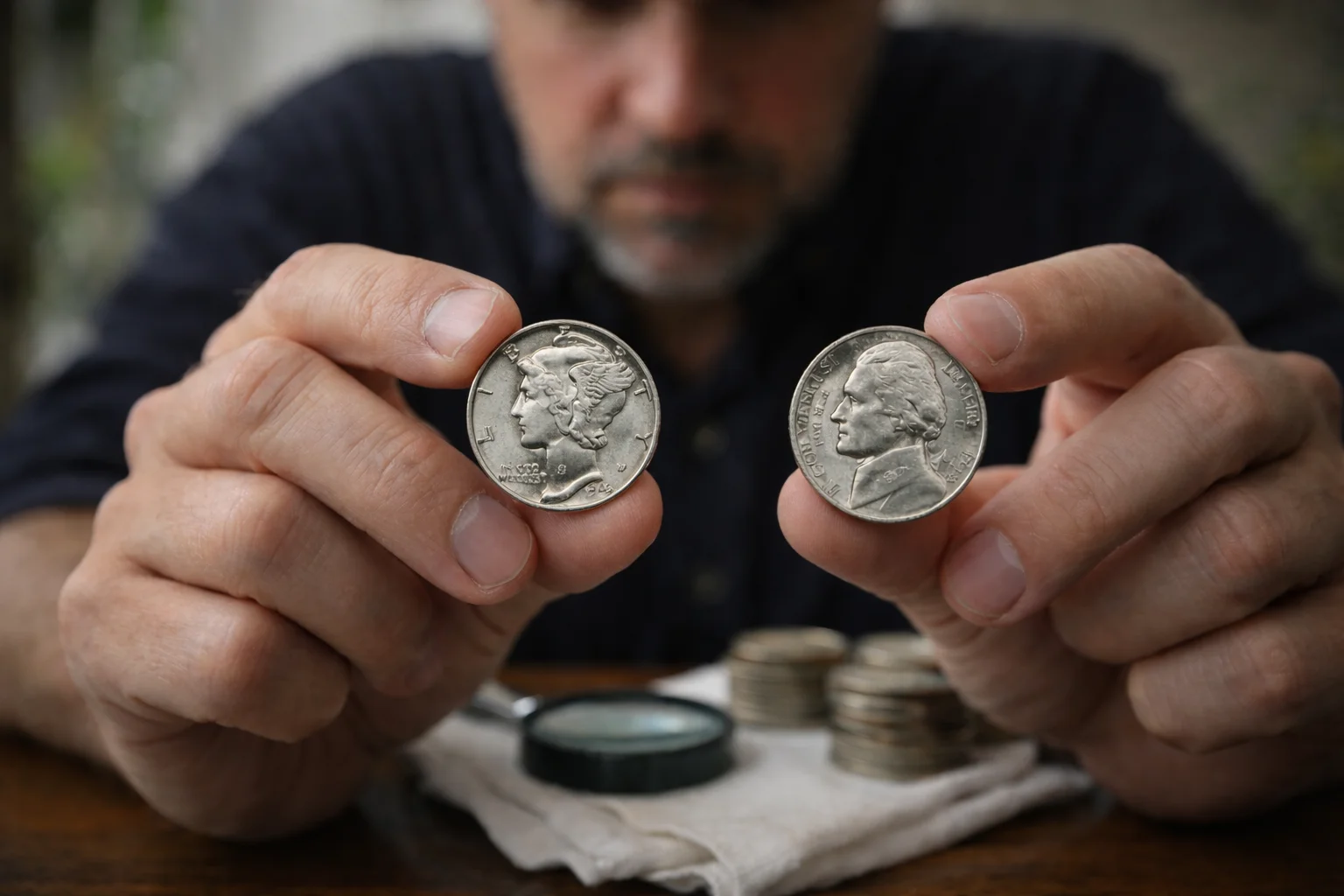
The Mercury dime did not change during the war: it contained 90% silver and 10% copper (since 1916). The U.S. Mint did not need to adjust the dime’s alloy.
The nickel was a different story. Nickel metal was required for military production. The Mint removed nickel from the five-cent coin and replaced it with a special wartime composition:
35% silver
56% copper
9% manganese
This alloy was used from late 1942 through 1945. To mark the change, the Mint placed a large mint mark above Monticello on the reverse. It was the first time a “P” mint mark appeared on a regular U.S. coin.
The dime remained traditional silver. The nickel became a wartime adaptation.
Technical Details Compared
Parameter | 1943 Liberty Dime | 1943 War Nickel |
Composition | 90% silver, 10% copper | 35% silver, 56% copper, 9% manganese |
Total Weight | 2.50 g | 5.00 g |
Pure Silver | 0.0723 troy oz | 0.0563 troy oz |
Diameter | 17.9 mm | 21.2 mm |
Edge | Reeded | Plain |
Designer | Adolph A. Weinman | Felix Schlag |
Mint Marks | None (P), D, S | Large P, D, or S above Monticello |
The dime contains more silver by percentage and also slightly more silver per coin. The nickel is heavier, but its silver content is lower.
From a metal standpoint, the dime has a stronger intrinsic position.
Silver Content and Melt Value
Melt value is calculated by multiplying the silver spot price by the coin’s pure silver content.
If silver trades at $25 per ounce:
Liberty dime: 0.0723 × 25 ≈ $1.81
War Nickel: 0.0563 × 25 ≈ $1.41
If silver rises to $30:
Dime ≈ $2.17
Nickel ≈ $1.69
The dime maintains a higher bullion floor at all price levels. This matters in circulated grades where condition premiums are small.
At the lower end of the market, the dime simply contains more silver.
Mintage Numbers
Both coins were struck in large quantities:
Mint | 1943 Mercury Dime | 1943 War Nickel |
Philadelphia | 191,710,000 | 271,165,000 |
Denver | 71,949,000 | 15,294,000 |
San Francisco | 60,400,000 | 104,060,000 |
Total | 324,059,000 | 390,519,000 |
What the Numbers Show
War Nickels were struck in higher total volume in 1943.
The 1943-D War Nickel has noticeably lower output than the 1943-D dime.
Philadelphia dominates production for both types.
Despite the large totals, neither coin is scarce by mintage alone. Tens or even hundreds of millions of pieces were produced. Real market separation comes from condition, strike quality, and certification — not raw production numbers.
Design and Strike Complexity
The dime shows Liberty wearing a winged cap on the obverse and a fasces with an olive branch on the reverse. The design has high relief in certain areas, especially in the central bands of the fasces.
Strike sharpness is critical. Weak pressure or worn dies often reduce detail in the central bands. That weakness affects collector interest and grading.
The War Nickel has a flatter design. Jefferson’s portrait is lower in relief. Monticello on the reverse includes steps that can show softness, but the market does not treat step detail the same way it treats Full Bands on the dime.
The dime’s design offers more technical grading checkpoints. The nickel’s design is simpler and less sensitive to minor strike differences.
From a strike-analysis perspective, the dime has more nuance.
Condition Rarity in High Grades
In circulated grades, both coins are common. They trade close to melt.
In Mint State, the structure changes.
Liberty dimes in MS63 and MS64 remain available. At MS65, premiums increase. At MS66 and especially MS67, the population narrows. Add a Full Bands designation, and scarcity increases further.
War Nickels also exist in high grade. MS65 pieces are common. MS66 coins are available. MS67 becomes selective. MS68 examples are scarce but still trade in a narrower market compared to top Liberty dimes.
Registry competition favors the Mercury dime series. The set runs from 1916 to 1945 and includes key dates. High-grade collectors actively compete for top examples.
The War Nickel series is short. It runs from 1942 to 1945. Demand is steady but less intense.
At the upper end of the grading scale, the dime generally commands stronger premiums.
Market Depth and Collector Base
The Liberty dime is one of the most popular 20th-century U.S. coin series. Its design by Adolph A. Weinman is widely admired. Many collectors build complete sets. Others specialize in Full Bands examples.
The War Nickel appeals to:
WWII history collectors
Type collectors
Silver accumulators
Its collector base is solid but narrower. It does not have the same aesthetic reputation.
The dime benefits from a larger long-term following.
Bullion Buyers vs Numismatic Buyers
The two coins behave differently depending on the buyer.
Bullion-Focused Buyers
Look at the silver content.
Buy in volume.
Ignore strike details.
Prefer recognizable 90% silver coinage.
For this group, the Liberty dime is slightly more efficient due to its higher silver weight.
Numismatic-Focused Buyers
Examine luster.
Inspect strike sharpness.
Seek certified examples.
Compete for higher grades.
For this group, the Mercury dime offers more grading layers and premium levels.
The War Nickel functions more often as a silver vehicle with historical interest. The dime bridges bullion and condition rarity more effectively.
Wartime Context and Historical Appeal
Both coins represent wartime America.
The Mercury dime maintained the traditional silver standard during the war. It reflects continuity in coinage.
The War Nickel reflects adaptation. Its alloy change was driven by military necessity. The large mint mark symbolizes that shift.
From a historical standpoint, the nickel tells a more direct wartime story. But if it comes to design, the dime offers more artistic details.
The historical appeal is balanced, but the storytelling differs.
Long-Term Price Behavior
Silver cycles influence both coins in lower grades. When silver rises, circulated examples increase in value. When silver falls, prices compress toward melt.
High-grade behavior differs.
Top Mercury dimes, especially those with strong strike and Full Bands, are less dependent on silver price. Their value depends on population data and collector competition.
High-grade War Nickels also respond to rarity, but their premium levels tend to be less dramatic.
The dime shows stronger separation between bullion value and condition premium.
Entry Cost and Accessibility
War Nickels are generally inexpensive in circulated and lower Mint State grades. They provide a low-cost entry into WWII silver coinage.
At the melt level, Mercury dimes trade higher because they contain more silver. In Mint State, the gap widens.
War Nickels usually cost less and are easier to enter with a small budget. Mercury dimes require a slightly higher outlay but offer stronger upside in higher grades.
Which One to Choose?
If the goal is silver accumulation, the Mercury dime provides more silver per coin.
If the goal is assembling a short WWII-focused set, the War Nickel offers simplicity.
If the goal is high-grade registry building, the Mercury dime has deeper competition.
If the goal is type collecting, either coin can serve the purpose, though the dime often carries a stronger aesthetic appeal.
There is no universal answer. The decision depends on the collecting strategy.
Final Comparison
Factor | Advantage |
Silver per Coin | Mercury Dime |
Wartime Alloy Story | War Nickel |
Strike Complexity | Mercury Dime |
High-Grade Premium Potential | Mercury Dime |
Entry-Level Affordability | War Nickel |
Collector Base Depth | Mercury Dime |
Conclusion
The 1943 Liberty dime and the 1943 War Nickel share a wartime origin but serve different roles in the market.
The dime carries higher silver content, stronger strike sensitivity, and deeper collector demand. It functions both as bullion and as a condition rarity in upper grades.
The War Nickel offers historical significance tied directly to wartime alloy changes. It provides affordable access to silver coinage from the same era.
For those who prioritize metal weight and long-term numismatic structure, the dime often stands ahead. For those who value affordability and historical adaptation, the War Nickel remains appealing.
Before making a purchase, check all details and compare the current price with the Coin ID Scanner. It provides access to a large coin database and a built-in assistant that helps verify type and technical parameters quickly. Accurate identification prevents confusion and supports informed decisions.
Both coins represent WWII America. The better choice depends on how you collect.